
Checking Criminal History in Rocky Mount
Begin with the record closest to the event. Rocky Mount Police Department records can identify an incident report or recent bulletin entry. The next step depends on where the conduct occurred. A Nash-side filing moves through the Nash County Clerk of Superior Court, while an Edgecombe-side filing may belong to the Edgecombe clerk. The statewide eCourts Portal supplies public docket leads for both counties, but it is not a certified criminal-history report.
- Search Rocky Mount Police2Citizen for a public report or daily bulletin entry.
- Use the RMPD Records Unit or formal form when the public interface does not show the needed city record.
- Confirm whether the event occurred in Nash or Edgecombe before choosing a clerk or detention channel.
- Search the North Carolina eCourts Portal, then ask the correct clerk for an official copy or older paper file.
- For review of your own fingerprint-supported state history, use NCSBI Right to Review rather than a city report search.
This sequence keeps police allegations, jail custody, court action, and repository history separate. It also prevents a common Rocky Mount error: treating the closest judicial building as proof of the county that owns a case.
Rocky Mount Records Cross County Lines
Rocky Mount spans Nash and Edgecombe counties. State population estimates allocate 40,655 residents to the Nash side and 15,375 to the Edgecombe side, but city police services and published RMPD crime figures cover Rocky Mount as a whole. A street address or incident location matters more than the requester's home address. Ask RMPD for the report first, then confirm the filing county from the citation, case number, or agency response.
The official Rocky Mount Judicial Center page identifies the building at 305 Cokey Road as an Edgecombe County facility.
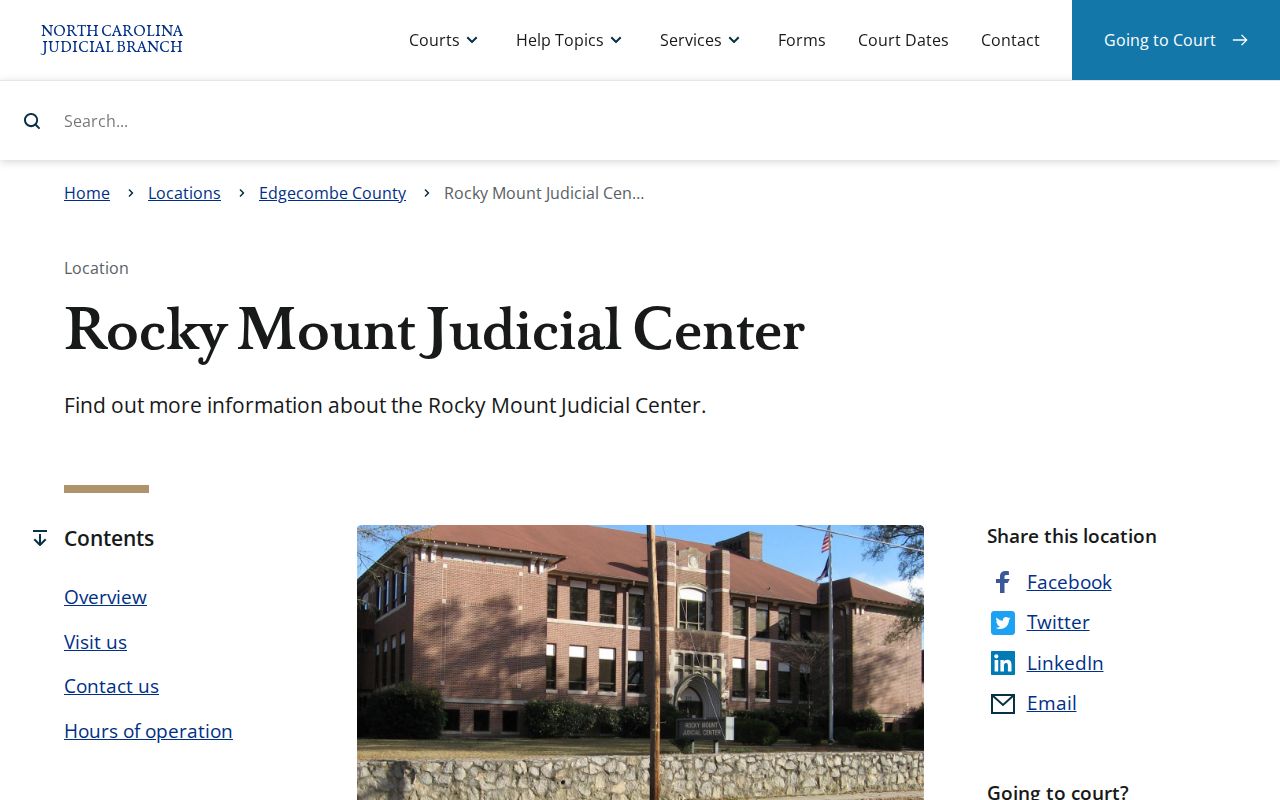
That label is a key routing clue. Nash-side Rocky Mount cases are not transferred there merely because the building carries the city's name. Nash cases remain with the Nash Clerk in Nashville.
Use the location of the reported conduct, not just a Rocky Mount mailing address, to test jurisdiction. The citation or report may name a county, and the eCourts case summary can supply a filing location. When neither is clear, give RMPD the event date, street, and report identifier and ask which clerk received the charge. That check also helps identify the proper paper-file counter and the county detention office that may hold a related booking. It prevents a Nash record request from being sent to the Edgecombe facility simply because both records carry the Rocky Mount name.
Rocky Mount Police Department Records
RMPD Records is at 330 S. Church Street, Rocky Mount, NC 27804. The Records Unit number is 252-972-1430, the police main line is 252-972-1411, and the listed fax is 252-972-1528. The unit maintains the city police layer, such as public incident and accident reports. It does not issue a certified Nash County court search, decide a case outcome, or provide an SBI rap sheet.
The city's Records Unit directory confirms the office and direct contact.
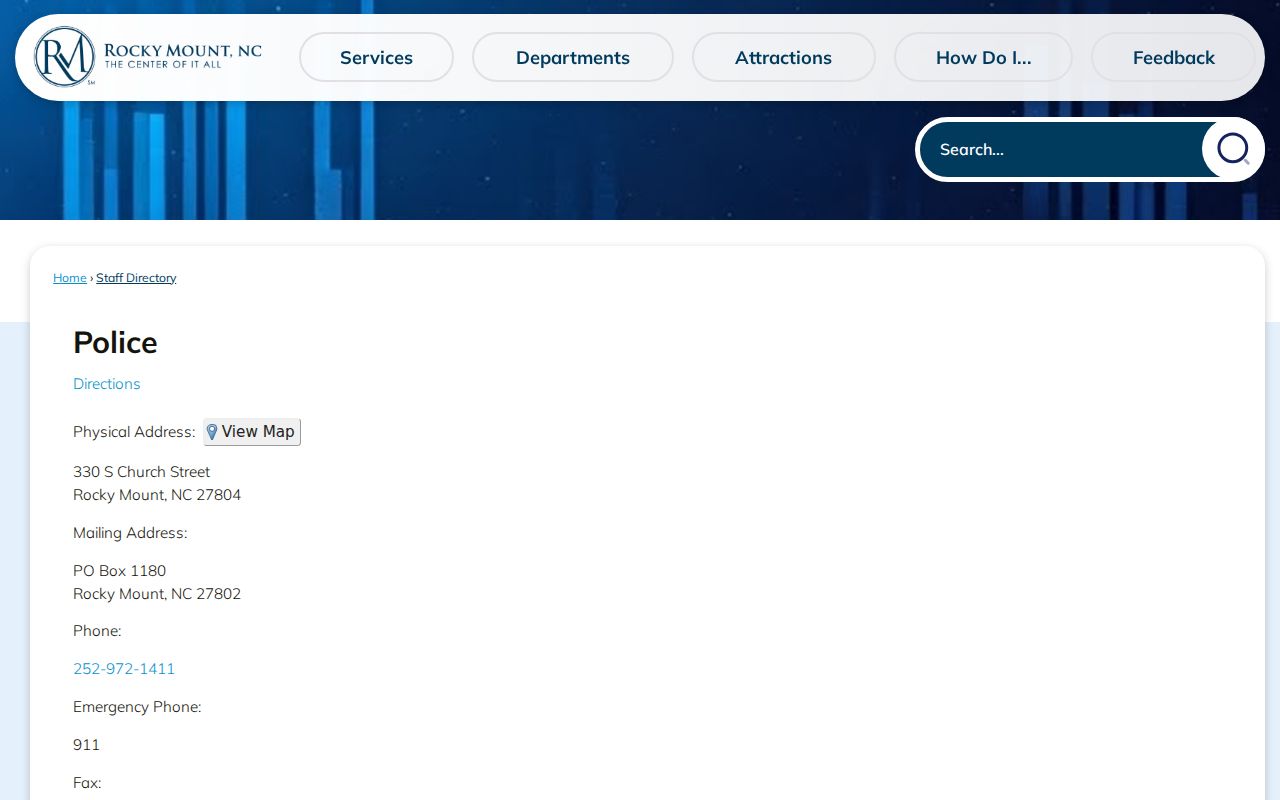
Calling the direct records line can save time when a report is too recent for Police2Citizen or when a requester needs to know whether a specific item can be released.
Rocky Mount Police Request Options
RMPD's formal Police Public Records Request form separates five products: radio recording, telephone recording, CAD record, incident report, and accident report. Those choices are not interchangeable. A CAD record logs dispatch activity, while an incident report is the agency's written event record. Radio or telephone audio may require review and redaction before release.
The official Rocky Mount request form shows the five choices and the details needed to locate them.
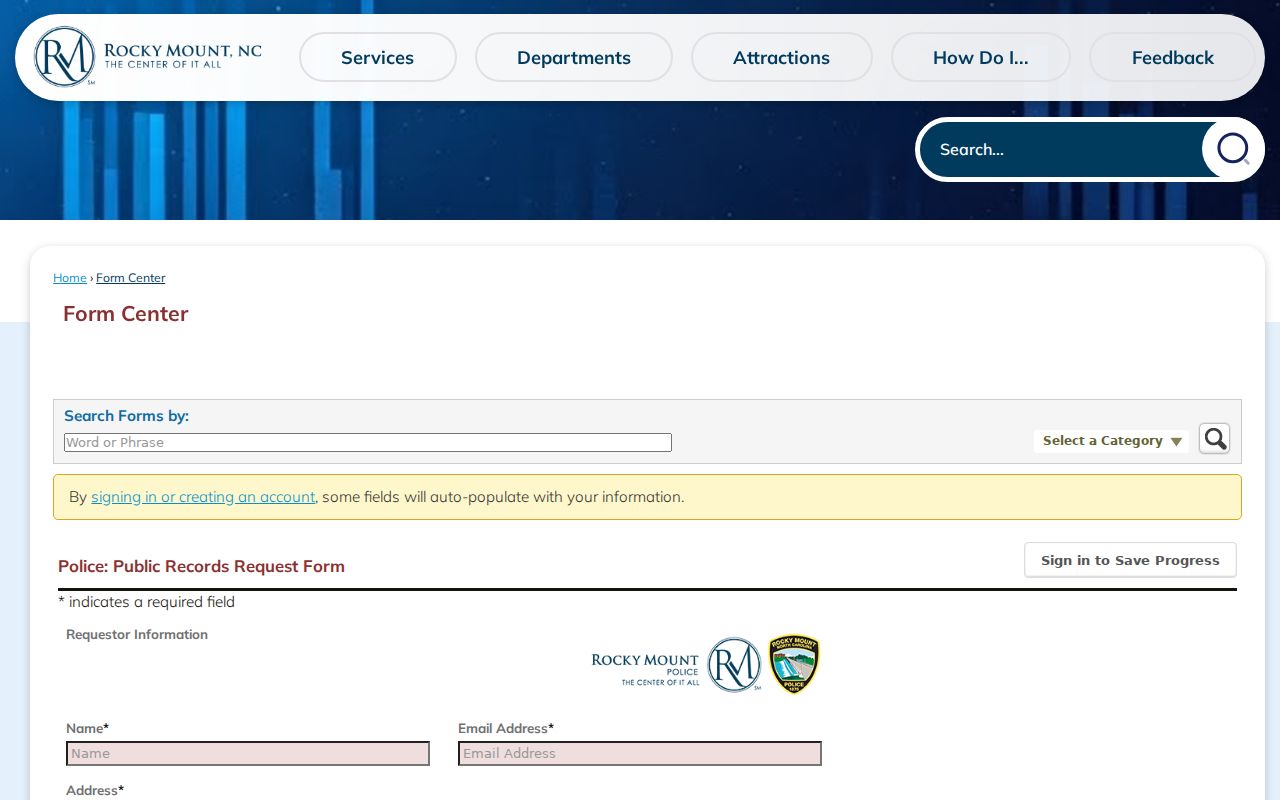
Supply the incident date and time, location or business, and a clear description. An Event ID or IR number is optional, yet either identifier can reduce mistaken matches. The form also asks for requester contact details and states that electronic delivery will be used where possible.
Note: RMPD says audio may be available for only 30 days, so an audio request should not be delayed.
Rocky Mount Arrests and Bookings
A Rocky Mount arrest starts as an agency record. Police2Citizen may show a public report or daily bulletin entry, but the item reflects police activity, not a finding of guilt. If a person is committed to Nash custody, detention records sit with Nash County. An Edgecombe-side arrest can follow a different jail and clerk route. Confirm the custody agency instead of assuming every RMPD arrest goes to the same county facility.
Once charges are filed, the court docket becomes the best source for hearings, dispositions, and judgment information. The broader Nash County arrest lookup explains county detention and agency fallbacks, while Rocky Mount-specific report requests remain with RMPD.
Recent activity may appear before the full disposition reaches the court and SBI systems. Check again with the clerk if a report lists an allegation but no court result. An arrest is not a conviction.
Rocky Mount Bulletins Are Not Dispositions
Police2Citizen offers printable public reports and a daily bulletin. It is useful for finding the agency record, date, and event context. It does not replace the case summary or disposition maintained by the clerk. A bulletin item can appear when no charge was filed, and a filed charge can later be dismissed, amended, or resolved under a different offense label.
The official Police2Citizen home screen is the correct public starting point for that city layer.
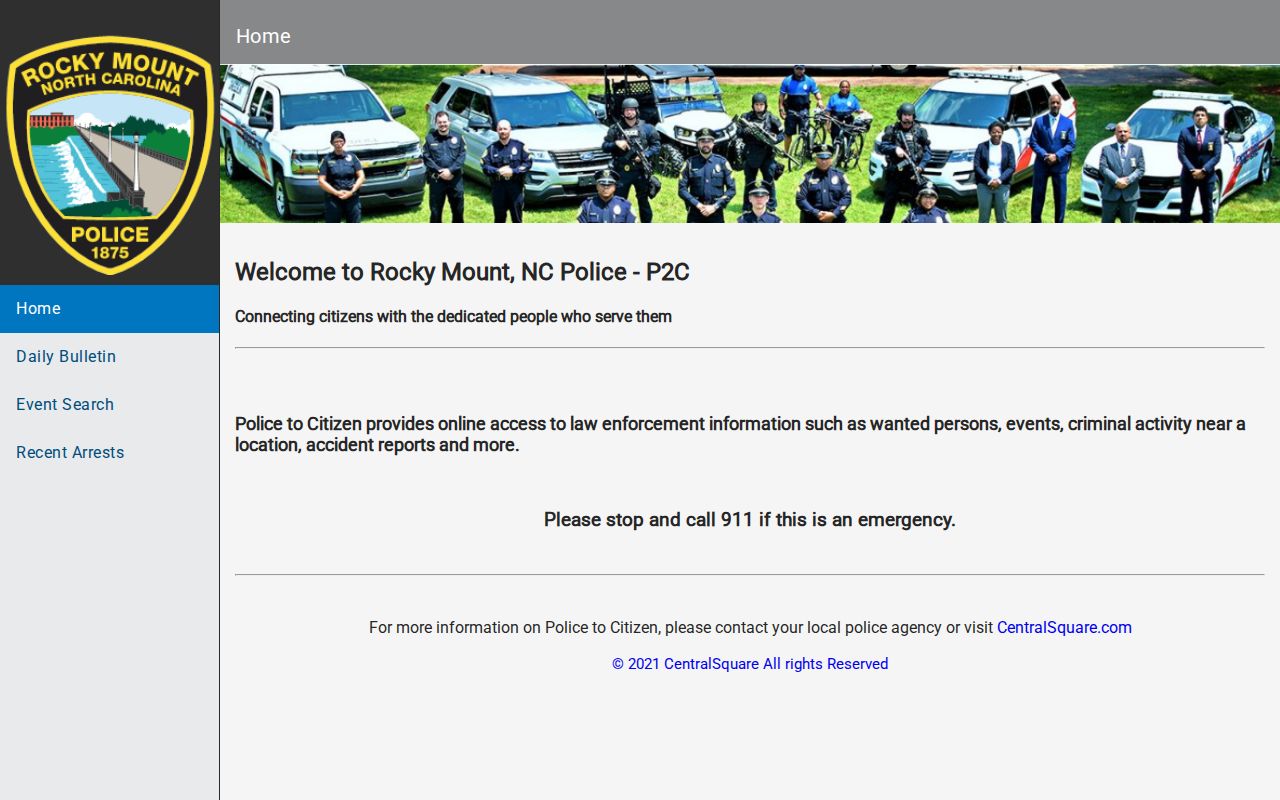
Use the date and report identifier found there to request the source report. Then search the correct county court file for the legal outcome. This two-source check is especially important in a city divided by a county line.
Municipal Court Records in Rocky Mount
North Carolina has no separate Rocky Mount municipal court. District and Superior Court operate within the unified state Judicial Branch. District Court hears misdemeanors, infractions, and preliminary felony matters. Superior Court conducts felony trials. The Clerk of Superior Court maintains both sets of files in the county where the case was filed.
| Court Name | No Rocky Mount municipal court; use Nash or Edgecombe District and Superior Court. |
|---|---|
| Case Types Heard | District Court handles misdemeanors, infractions, and early felony stages; Superior Court tries felonies. |
| Case Lookup Channel | North Carolina eCourts Portal, courthouse public terminal, or the filing county's Clerk. |
| What the Docket Shows | Case summary, parties, events, hearings, disposition, judgment, and public financial entries. |
| Copies & Fees | Public terminal searches are free; ask the filing Clerk about paper or certified copies. |
A Rocky Mount magistrate line, 252-212-3119, may help identify the early judicial channel. It does not by itself establish whether Nash or Edgecombe owns the case.
Rocky Mount Crime Totals Need Context
NCSBI's 2024 agency table reports 2,582 index offenses for RMPD: 8 murder, 21 rape, 85 robbery, 301 aggravated assault, 402 burglary, 1,565 larceny, and 200 motor-vehicle theft. These are offenses reported by the police agency. They are not counts of people, arrests, convictions, or open cases.
The total is citywide because RMPD serves Rocky Mount across Nash and Edgecombe. It cannot be presented as a Nash-only count or used to calculate a Nash-side city crime rate. For one person's record, follow the report and case number. Broad statistics cannot answer whether that person was charged or how a court ruled.
The category labels also describe offenses known to the reporting agency, not the final charge selected by a prosecutor. One event can generate several record layers and can change as facts are reviewed. For a historical or neighborhood question, keep the RMPD table's citywide scope attached to the figures. For a specific Rocky Mount case, set the table aside and trace the incident number into the correct county docket. That narrower method distinguishes a reported event from an arrest, and an arrest from a conviction.
Where Rocky Mount Records Go
RMPD creates the city incident or arrest record. A filed charge then moves to the clerk in the county of jurisdiction. Court events and the public disposition appear in Odyssey and the eCourts Portal. For fingerprintable events, RMPD sends prints and arrest information to the North Carolina State Bureau of Investigation, and courts later report dispositions for matching to that arrest cycle.
Record flow: Rocky Mount Police Department › Nash or Edgecombe County Courts › North Carolina State Bureau of Investigation
Each stop can update on a different schedule. A recent Rocky Mount report can exist before a court case is indexed. A court disposition can also be missing from a fingerprint-supported state response. For self-review, compare the source agency report, the correct clerk file, and NCSBI Right to Review.
Rocky Mount History Explains the Split
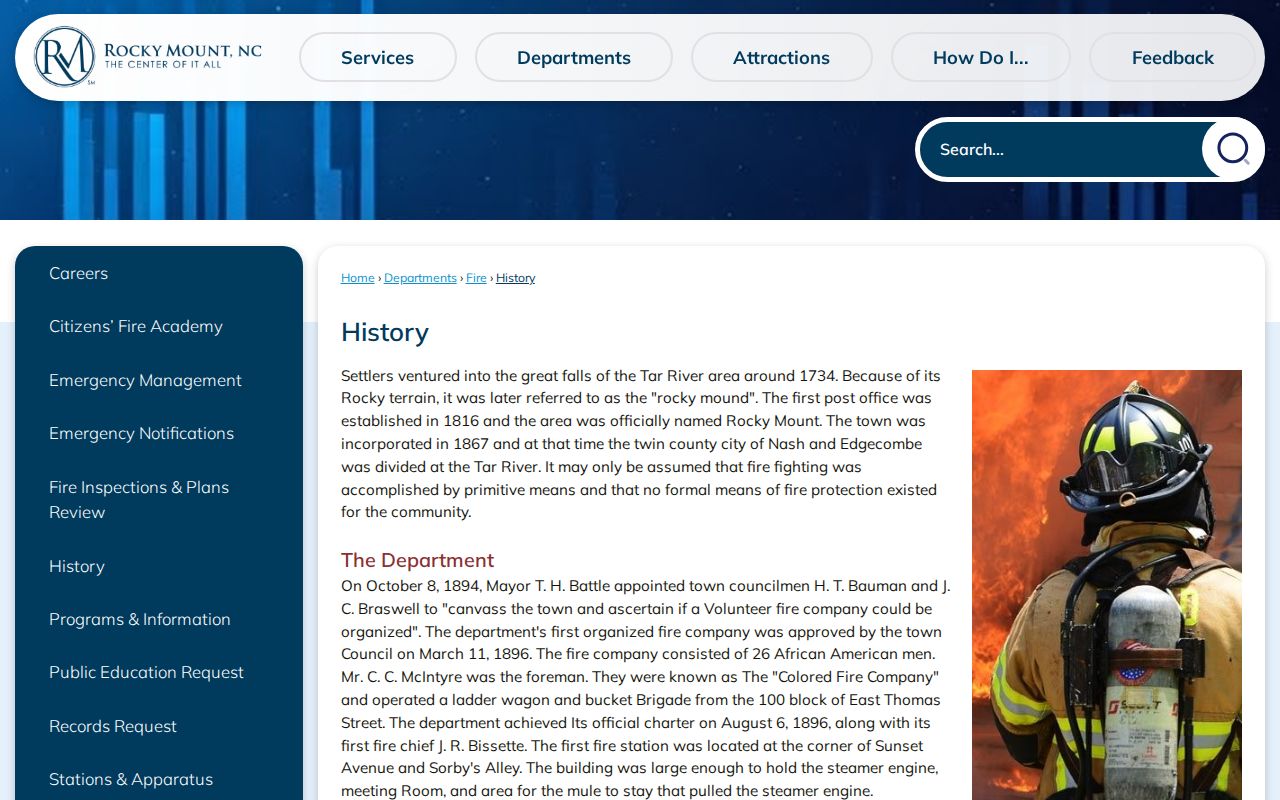
Rocky Mount incorporated in 1867 and grew around the Tar River and railroad landscape. The county line is not a new records boundary created by modern police systems. It is part of the city's long geography, which is why current searches must still distinguish Nash from Edgecombe.
The city's official historical material gives that local setting.
Rocky Mount also has seven National Register districts. Rocky Mount Mills Village lies on the Nash side and includes 74 contributing resources tied to the state's second-oldest cotton mill. Those facts help locate an old address, but historic research still depends on the county that preserved the court file.
Changes in street names, property descriptions, or city boundaries can matter when older material is searched. A precise date and the address used at the time may help RMPD or a clerk separate similar events. For genealogy, begin with the filing county and ask whether the source is in the current electronic system or an older paper file. Rocky Mount's history gives useful place context, but it does not merge the two counties' archives.
Rocky Mount Criminal Record Contents
A city police record may identify the agency, event time, alleged offense, report number, and public narrative. A court record instead organizes the case number, status, parties, events, hearings, disposition, judgment, and public financial information. NCSBI Right to Review focuses on the requester's North Carolina fingerprint-supported arrest cycles and linked dispositions.
- Daily bulletin
- A public police activity listing, not a judgment or full criminal history.
- CAD record
- A dispatch record that is distinct from an officer's incident report.
- Disposition
- The court's recorded outcome, such as dismissal, conviction, or another resolution.
- Right to Review
- The subject-only process for obtaining one's own fingerprint-supported NCSBI history.
A missing item does not always mean no event occurred. Wrong-county routing, name collisions, delayed disposition reporting, and records restricted by law can all affect what appears.
Public Access Rules in Rocky Mount
Public access depends on the record type. Court files are generally open during regular office hours unless another law restricts them. Police investigative and intelligence material is treated differently from basic public information. RMPD may redact or withhold protected details, recordings, witness material, juvenile information, or active investigative content. Expunction orders and other specific laws can also limit access.
Key Statutes:
North Carolina Public Records Law, Chapter 132 defines public records and includes special rules for criminal investigation information.
G.S. 7A-109 opens court records to inspection during regular office hours unless another law bars access.
Chapter 15A, Article 5 governs expunction and protects records covered by a granted order.
For an official or legally required check, use the correct government source. This privately operated resource is not a consumer reporting agency, and its search feature is not a substitute for NCSBI, a clerk-certified search, or another authorized process.