
Checking Criminal History in Nash County
Nash County has no single criminal history database. Begin with the North Carolina eCourts Portal for public case leads, then use the Nash County Clerk of Superior Court when a paper file, certified result, or current financial figure is needed. The sheriff or city police holds the source incident report. The jail holds booking and present-custody facts. The North Carolina State Bureau of Investigation keeps fingerprint-supported state history, while the North Carolina Department of Adult Correction tracks state custody and community supervision.
Gather the full name, spelling variants, an approximate filing or event date, and a case, citation, incident, or offender number if known. A date of birth can help an official office distinguish people, but do not assume a name match identifies the right person. Use the record number whenever the public system offers one.
- Search Criminal Actions in the North Carolina eCourts Portal, filtering to Nash County when the location is known.
- Open the case summary and read events, hearings, and the disposition as separate parts of the Nash County court record.
- Ask the Nash County Clerk to inspect the underlying file or supply a certified county search when proof is needed.
- Contact the arresting agency or detention office for the report and booking layer, which the court docket does not reproduce.
- For a review of your own fingerprint-supported state record, use NCSBI Right to Review and compare any missing result with the clerk file.
Nash County eCourts Record Search
Nash County moved to Enterprise Justice and Odyssey on April 28, 2025. Public portions now appear through one statewide Portal. Ordinary public searches are free and anonymous. Smart Search accepts a party name, record number, citation number, attorney name or bar number, business name, cross-reference number, or nickname. Filters can narrow results to Criminal Actions and the Nash County location. Search Hearings and NC Judgment Search offer other paths when a setting or indexed judgment is the goal.
| Portal control | Useful input | What to check |
|---|---|---|
| Smart Search | Name, record or citation number | Match county, case type, and identity |
| Criminal Actions filter | Advanced category | Exclude unrelated civil results |
| Search Hearings | Case, party, attorney, officer, or courtroom | Confirm the next setting |
| Judgment Search | Party or case number | Review status, index date, and comments |
For the $25 certified Nash-only clerk search, submit AOC-CR-314 by mail or at the counter. Mail accepts a money order or certified check, not a personal check. Counter payment may be made by credit card, cash, money order, or certified check. A courthouse terminal offers free public court searches and can email noncertified results.
Portal entries may appear soon after Odyssey upload, but volume can cause delay. A converted legacy event may display 12:00 a.m. because the prior system stored no time. That stamp does not prove an event took place at midnight. Downloads can be available online where authorized, while courthouse kiosks generally do not provide downloads. The clerk remains the source of a certified Nash County criminal record.
North Carolina Official Background Checks
The NCSBI Criminal Information and Identification Section is North Carolina's central fingerprint-based repository, but it offers no open public name search. A person may request that person's own North Carolina record through Right to Review. The process needs an FD-258 card with ten rolled impressions, a completed packet, photo identification shown to the fingerprinting official, and a $14 certified check or money order. The packet goes by mail to NCSBI, CIIS, Attention Applicant Unit, Right to Review, 3320 Garner Road, Raleigh, NC 27610. Personal delivery, private carriers, cash, and personal checks are not accepted.
The NCSBI personal review instructions show the official subject-only route.
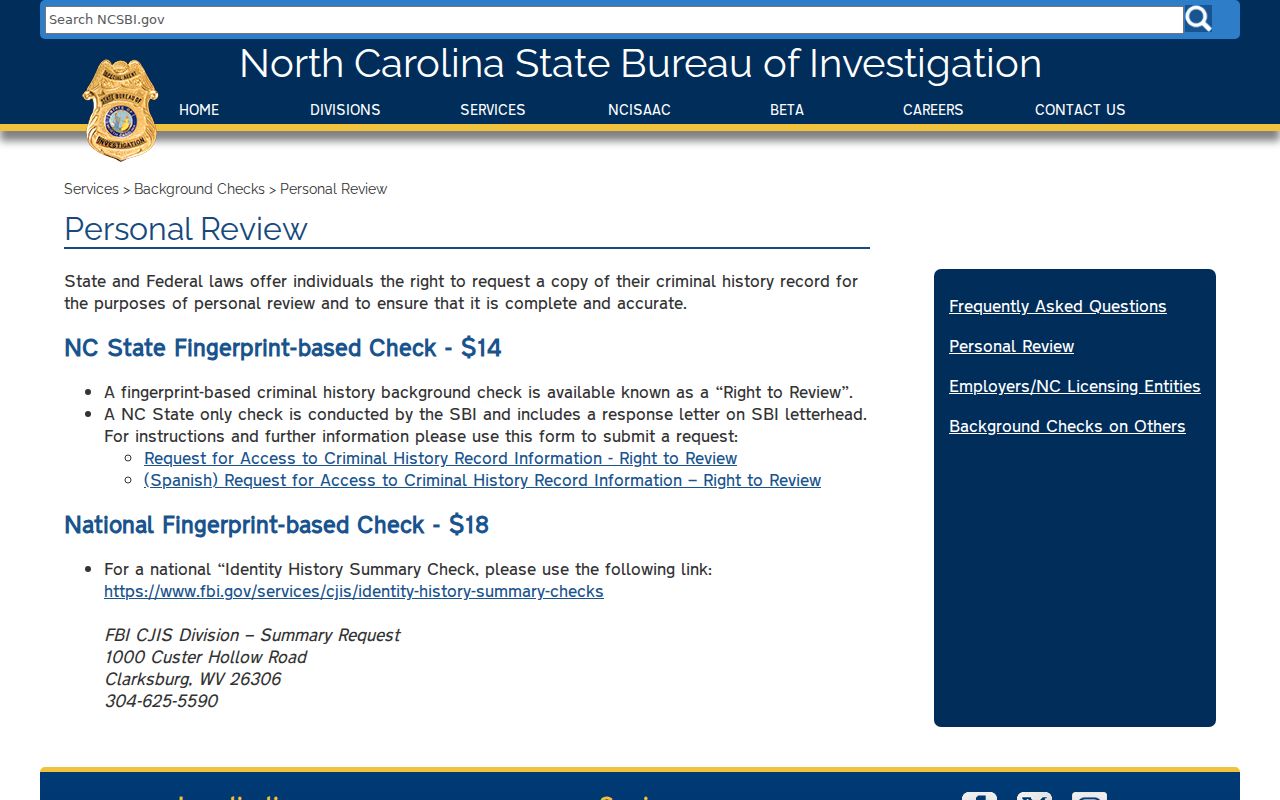
This fingerprint search covers supported North Carolina arrests and linked dispositions when received by SBI, not other states, federal history, local incident narratives, or current Nash County jail status. SBI mails the response to the subject and does not send it to another person. A written-exception process is available when a subject finds an error.
| Official channel | Cost | Scope |
|---|---|---|
| NCSBI Right to Review | $14 | Subject's fingerprint-supported North Carolina history |
| Nash Clerk AOC-CR-314 | $25 | Certified name search in Nash County court records |
| Courthouse public terminal | Free search | Public court information for one county or statewide |
Nash County Sheriff's Record Route
The Nash County Sheriff's Office does not publish a separate records division, records email, request portal, fee schedule, or set response time. Its county Form Center lists other sheriff functions, but no public-records request form. For a sheriff incident report, arrest information, warrant confirmation, 911 or CAD item, body-camera issue, or detention question, call 252-459-4121 or visit 222 W. Washington Street in Nashville. Name the record with care, give the event date and location, and ask which submission route and fee apply.
The official Nash County Sheriff's Office page identifies headquarters and its contact path.
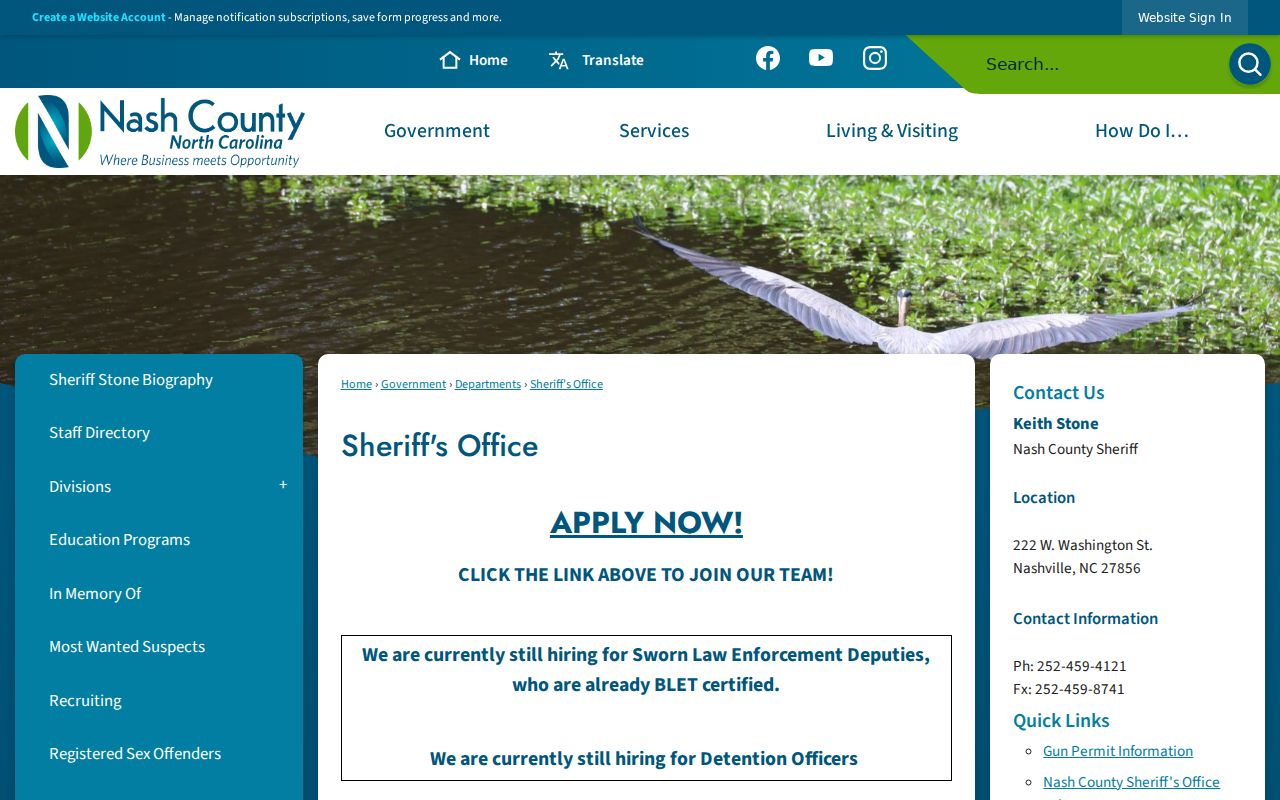
The office may treat an incident report, investigative file, recording, jail item, and warrant information in different ways. An active investigation, confidential source, victim detail, juvenile matter, or recording may be withheld or redacted under a more specific rule. Fax 252-459-8741 is published, but confirm that the office accepts a records request by fax. No records-specific email, mailing route, or drop-box rule was found. The free Nash County Sheriff NC Apple app supports tips, reports, news, and public-safety information, but its listing does not advertise a warrant or inmate lookup.
The Nash County Clerk is at 234 W. Washington Street and answers at 252-220-3000. That office handles criminal files, terminals, copies, and certified court searches, while the sheriff remains the source for sheriff reports and detention questions.
Criminal Record Types
A Nash County record search works best when the requested product is named precisely. Police and sheriff reports describe reported conduct and the agency's work. Booking data records jail intake and custody. Court files track filed charges and judicial outcomes. SBI links fingerprint-supported arrest cycles to reported dispositions. NCDAC covers state prison and community supervision, not a person held only in the county jail.
- Incident report
- The source agency's account of a reported event, which may exist without an arrest or filed charge.
- Booking record
- The jail intake and custody layer, separate from both the police narrative and the Nash County court file.
- Court case file
- The clerk's charge, event, hearing, disposition, judgment, and financial record.
- SBI criminal history
- A fingerprint-supported North Carolina repository record, not a copy of eCourts.
- Corrections record
- NCDAC state custody, probation, parole, or post-release information dating back to 1972.
Warrants and registry records are distinct again. An unreturned criminal warrant is restricted in Portal. The sheriff's Most Wanted page is curated and cannot clear a name. The North Carolina Sex Offender and Public Protection Registry contains statutory public information only for people required to register. More detail on public arrest channels belongs in the Nash County Arrest Lookup.
Nash County Jail Record Limits
Nash County publishes no official online inmate roster or searchable booking page. Call the sheriff and detention line at 252-459-4121, ask at the lobby, use NC SAVAN or VINE for victim notification when applicable, and move to the NCDAC search only after state transfer. An empty state corrections result does not show that no one is held at the county jail.
The official Nash County Detention Center page supplies the facility image and operating details.
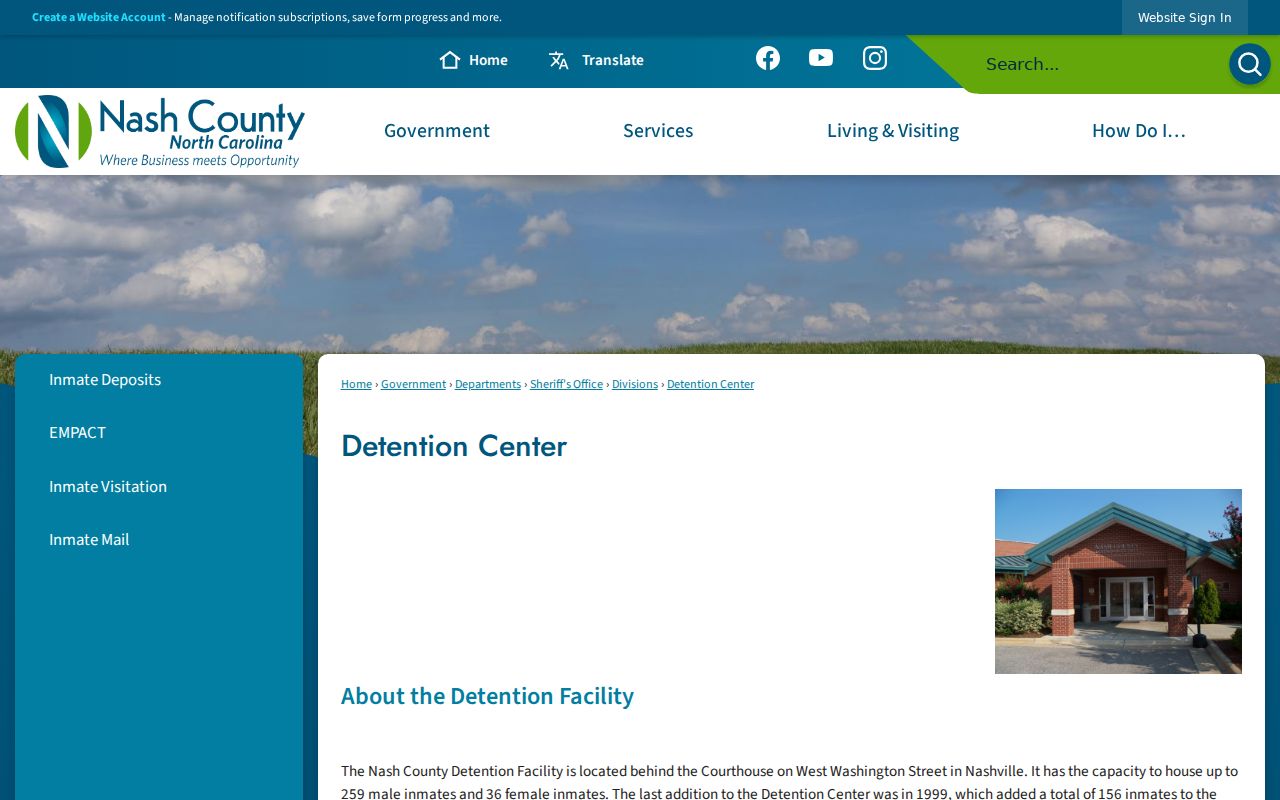
The detention facility reports capacity for 295 people, with 259 male and 36 female spaces. It sits behind the courthouse, yet booking and court records remain legally separate. Remote video visits may use up to six 15-minute intervals per day at $4.50 each through iWebVisit, and the county warns that visits are never private. Those visitation facts do not reveal charge disposition or prove guilt.
Nonlegal mail has been scanned offsite since December 1, 2022, under Facility ID 5141, with physical mail destroyed after scanning. That rule matters to families but does not create a searchable criminal history field. Nash County has not published a verified inmate-profile inventory, so claims about mugshots, cell assignment, bond by charge, or release time must be confirmed with detention.
Inside a Nash County Criminal Record
The fields depend on the custodian. A public eCourts file separates Case Summary, Case Information, assignments, parties, events, dispositions, hearings, and financial information. Judgment results can show the case number, disposition status, index time, parties, and comments. A Right to Review response instead ties identity to fingerprint-supported North Carolina arrest cycles and any matching dispositions received by SBI. Neither record promises the full police narrative or live Nash County custody.
| Name and identifiers | Public party identity in court, or the subject identity used for an SBI self-review. |
|---|---|
| Arrest or booking data | Held by the source agency and jail; the public Nash interface has no verified field list. |
| Charges | Allegations as filed, which may differ from the first arrest claim or final judgment. |
| Case events | A dated docket trail of hearings and filings, not a narrative incident report. |
| Disposition | The outcome used to distinguish dismissal, conviction, or another resolution. |
| Custody or supervision | County detention answers current jail custody; NCDAC tracks state custody and supervision. |
Portal financial figures are for reference, not a guaranteed current payoff. Contact the Nash County Clerk for the live amount. Documents shown online may be downloaded when access allows, while certified copies come from the clerk. Social Security numbers, juvenile matters, some protective-order information, expunged files, and unreturned warrants do not appear as ordinary public fields.
When Nash County Records Disagree
One arrest can create four files. The arresting agency writes its report. Detention creates a booking record if the person is committed. The clerk opens a judicial case when charging papers are filed. For a fingerprintable event, the agency sends prints and arrest data to SBI, while the court later reports the disposition. A missing fingerprint card, name mismatch, processing lag, changed charge, or unreported disposition can make those sources disagree.
If Portal shows a Nash County charge without an outcome, check the clerk file first. Ask whether a disposition was entered and whether the correct case and person were matched. Then obtain your SBI Right to Review if the state repository is at issue. A subject can file the NCSBI Criminal History Record Written Exception; CIIS audits the entry and works with the arresting agency before answering in writing.
A dismissal does not by itself erase an old agency or booking file. Expunction is a separate court remedy. Keep any granted order and contact the granting clerk if a public court source still displays the matter weeks later.
Note: A filed charge, an arrest, a booking, and an EMPACT placement are not findings of guilt.
Public Access Laws in North Carolina
North Carolina law opens many records but does not place every criminal history layer in one public pool. Court access rests on a court-specific law. Chapter 132 governs public records more broadly, while a distinct section limits criminal investigation and intelligence material. SBI dissemination, juvenile rules, victim protections, expunction orders, and the registry statute then narrow what a public search can reveal.
Key statutes:
G.S. 7A-109 makes nonrestricted court actions, judgments, and proceedings open for inspection during regular office hours.
Chapter 132 states North Carolina's general Public Records Law.
G.S. 132-1.4 sets special access rules for criminal investigation and intelligence information, including basic information and protected material.
G.S. 15A-151 protects expunction files except for the official uses listed by law.
G.S. 14-208.10 and Article 27A establish the public registry framework and its lawful public-protection purpose.
Ask for a narrow Nash County record by event date, location, incident number, and responsible agency. Specific facts help the custodian find the right file and explain any redaction. Public access to a docket does not unlock a police narrative, and access to registry information does not remove confidentiality from another system.
Nash County Warrant Record Gaps
Nash County has no complete public name-searchable warrant database. The sheriff's Most Wanted interface displays a selected set of wanted subjects, not every active warrant. Portal restricts unreturned criminal warrants. Therefore, no result in either source proves that no warrant exists.
For a possible warrant in your own name, treat the online list only as a lead. Call the Nash County Sheriff's Office for confirmation, check with the relevant magistrate and clerk, and use the public docket for returned events. Nashville magistrates answer at 252-220-3019, while the Rocky Mount magistrate line is 252-212-3119. Ask which court issued the process, whether service remains pending, and what court step is required for safe resolution. Qualified counsel can help plan that response.
A city does not maintain a separate municipal-court warrant database in North Carolina's unified court system. Rocky Mount also crosses the Nash and Edgecombe line, so first identify the county of the event. The Rocky Mount Judicial Center on Cokey Road is an Edgecombe facility and does not replace the Nash County Clerk.
Sealed, Expunged, and Restricted Records
North Carolina calls record-clearing relief expunction. A person files the statute-specific AOC petition with the clerk in the county of the charge or conviction. Some petitions require affidavits, record checks, service, or a hearing. The usual fee is $175, while petitions based on dismissal or a not-guilty result are generally free unless linked to a diversion or deferred prosecution. An indigent filer may seek a fee waiver. Processing can take several months.
A granted order directs covered agencies to seal or destroy the qualifying record and may allow the person to deny the event in many settings. It may not remove every federal, immigration, or other consequence. Keep the signed order. G.S. 15A-145, 15A-145.5, 15A-146, 15A-149, 15A-150, and 15A-151 address different forms of relief, notice, and confidentiality. Session Law 2025-71 also changed the waiting period for one eligible nonviolent misdemeanor to three years after the later of conviction or completion of active punishment, probation, or post-release supervision.
Juvenile delinquency relief follows separate rules. If a Nash County court display remains visible after relief, contact the granting clerk. If the problem is in an SBI response, use the written-exception process. Eligibility turns on the actual statute and full record, not just the short charge label.
Nash County Crime Record Context
The Census Bureau estimated 99,365 Nash County residents on July 1, 2025, up 4.6% from the 2020 count. The county covers 540.44 square miles. One Nashville records cluster thus serves a growing population spread across rural land and a large share of Rocky Mount, a city divided between two counties.
NCSBI's 2023 county summary reported an index-crime rate of 2,027.1 per 100,000, compared with 1,844.3 in 2022. The violent-crime rate was 355.3, while the property-crime rate was 1,671.9. These are source-defined rates, not raw counts. They do not equal the number of arrests, defendants, convictions, active cases, or people now in custody. Never use a county trend to infer facts about one person.
Sheriff Keith Stone has served since December 2014. The official sheriff biography names the Sheriff's Action Team, Special Response Team, Tar River Regional Task Force, heroin initiative, training work, and community programs.
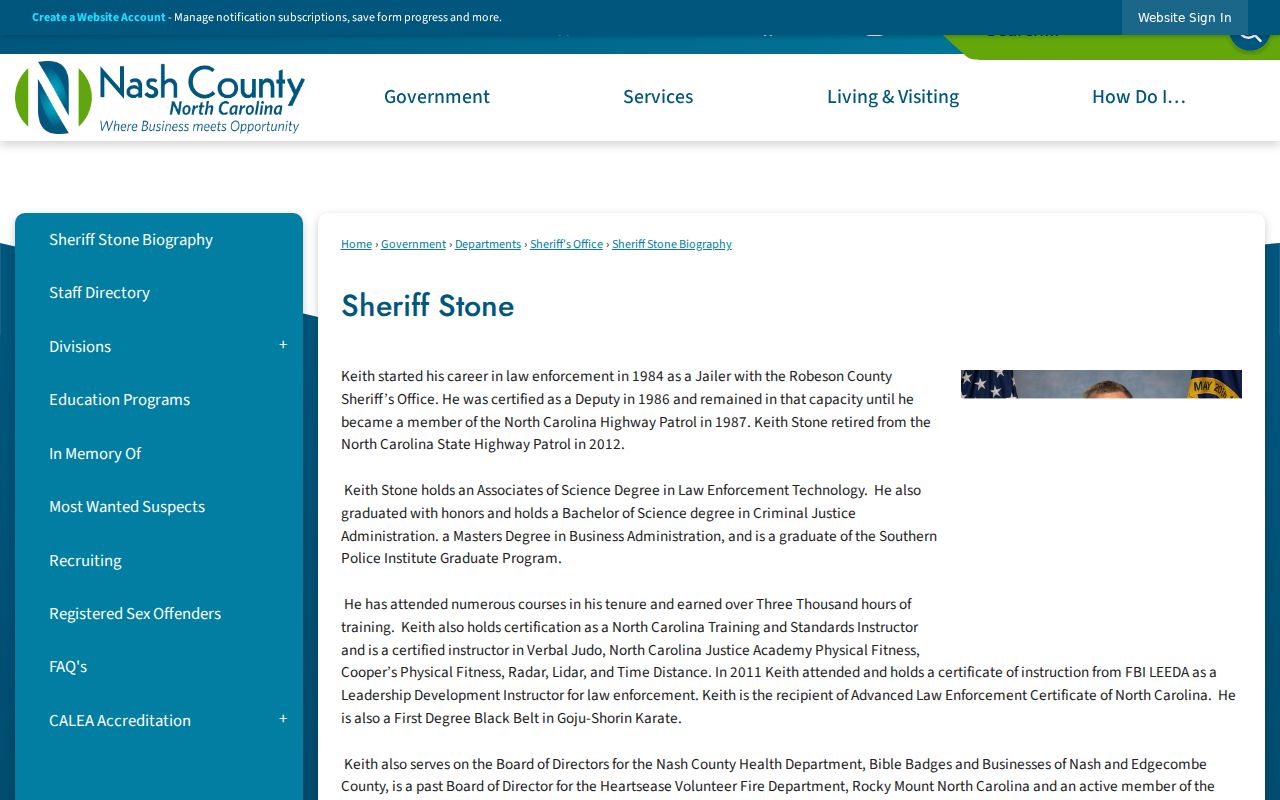
Those programs help explain which Nash County agency may create a source report, but a program name never establishes arrest, charge, or guilt for any person.
Nash County Criminal Records by City
Local routing changes by place even though North Carolina has no city municipal courts. Rocky Mount and Nashville police create their own agency reports. Red Oak has no listed municipal police department, so its law-enforcement records begin with the Nash County Sheriff's Office. Filed Nash-side cases reach the same county clerk and eCourts system. Official 2024 estimates rank Rocky Mount, Nashville, and Red Oak as the county's three largest incorporated places.
Rocky Mount Criminal Records
56,030 citywide · Police2Citizen and a city request form serve both county sides, so confirm case jurisdiction.
Nashville Criminal Records
5,972 · Town police reports, sheriff bookings, and clerk files use three distinct record channels.
Red Oak Criminal Records
3,504 · The sheriff is the law-enforcement record source because Red Oak has no listed municipal police agency.
In each city, match the source agency first, then confirm filed charges and outcomes through the Nash County Clerk when the event belongs on the Nash side.
Nash County Records on Washington Street
The county's justice records sit close together in Nashville. The Nash County Courthouse at 234 W. Washington Street holds District and Superior Court files. Sheriff headquarters is next door at 222 W. Washington Street, and detention stands behind the courthouse. Physical distance is short, but the legal separation is firm: the sheriff knows the source report, detention knows booking and custody, and the clerk knows filed charges and outcomes.
The North Carolina Judicial Branch courthouse page provides the official building photograph and counter details.
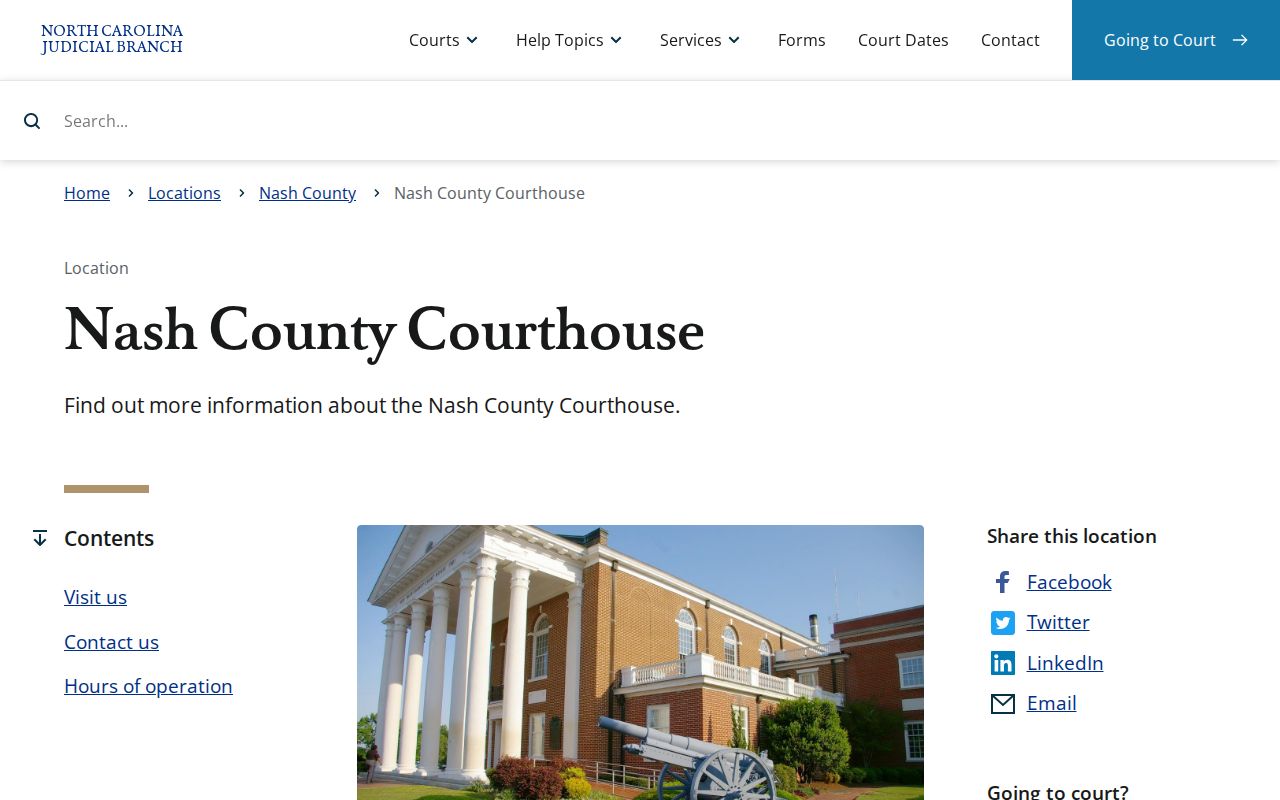
Published clerk hours include a midday closure. Monday, Tuesday, Wednesday, and Friday run 8:30 a.m. to 12:30 p.m. and 1:30 to 5 p.m.; Thursday resumes at 1 p.m. after the 12:30 close. Call 252-220-3000 before travel because official sources did not state dependable parking, security, recording, or phone rules.
Nash County formed from western Edgecombe in 1777, and Nashville became the early court seat before incorporation in 1815. That history explains why the record core remains here even though Rocky Mount is much larger. Accessibility and language accommodations are available through Judicial Branch services and should be requested for the specific event in advance.
EMPACT in Nash County Records
EMPACT is Nash County's GPS-monitored alternative to secure detention for selected nonviolent pretrial participants. An ankle cuff and belt device allow around-the-clock location monitoring, with curfew and place restrictions. Investigators may compare monitoring history with a crime scene. The program is a form of pretrial release, not a conviction, jail sentence, or proof that an allegation is true.
A Nash County court docket may show the pending case and conditions while the sheriff's EMPACT program holds its own operational material. That split follows the same rule found across local criminal records: a status in one system does not supply the whole case outcome. Read the later disposition and judgment before drawing a conclusion.
Probation, parole, and post-release supervision are different. They are state-run through the NCDAC Division of Community Supervision. The Offender Public Information Search covers active and historical state offenders since 1972, including probationers and parolees, but leaves out county-jail-only custody and does not turn detailed supervision files into public records.